
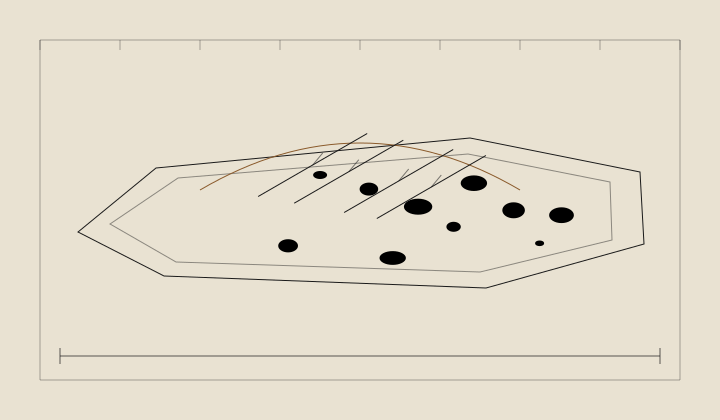
Every other entry in this ledger gets compared to this loaf. It is not the most exciting bread here, and that is the point: 88% stone-milled bread flour, 12% sifted whole wheat, 78% water, 2% salt, and a starter built 1:5:5 the night before. If a change to my schedule cannot beat this loaf, the change gets written down as a note and not as a habit.
Why 78% water and not 85%
At 12.2% protein the flour will carry more water than this, but past roughly 80% the dough stops behaving predictably in a home kitchen: it spreads in the banneton, the scoring drags, and the crumb gets big holes next to a gummy band. At 78% I get an open crumb and a shape that still stands up after a 14-hour cold retard. If your flour is closer to 11.5% protein, start at 74% and add 5 g of water per loaf per bake until the dough feels like a soft earlobe and not like a batter.
Building the starter at 1:5:5
The levain is 20% of total flour weight. I take 20 g of refrigerated starter, feed it 100 g flour and 100 g water at 24 °C, and use it at hour nine, when it has domed and just begun to flatten. A 1:5:5 feed gives about nine hours of usable window at that temperature; a 1:2:2 feed would give three and would be past peak before the dough is mixed.
| Clock | What the levain looks like | Action |
|---|---|---|
| Hour 0 | Flat, pasty, smells like yoghurt | Mix 1:5:5 at 24 °C |
| Hour 5 | 60% risen, domed shoulders | Wait |
| Hour 9 | Full dome, one or two holes on top | Mix the dough now |
| Hour 11 | Falling, acetone smell | Too late for this loaf |
Bulk at 25 °C and the fold schedule
Four sets of slap-and-fold, 90 seconds each, 45 minutes apart. The dough starts at 24 °C and I let it drift to 26 °C by the last set. Bulk ends at 4.5 hours when the dough has gained about 55% in volume and shows a few bubbles at the edges of the tub.
- Set 1 (0:00): the dough looks shaggy and tears.
- Set 2 (0:45): it stretches to 40 cm without breaking.
- Set 3 (1:30): it feels like a full balloon and holds a window.
- Set 4 (2:15): it is smooth and slightly tacky, and I stop touching it.
Then 14 hours at 4 °C. The cold dough goes into the oven straight from the fridge, scored cold, because a warm dough slumps and closes its own cut.
Scoring, steam and the numbers that matter
One long shoulder slash at 30 degrees, 6 mm deep, plus two short side cuts that give the loaf somewhere to open if the main cut seals. 245 °C on a stone preheated 45 minutes, 20 minutes with steam, 45 minutes total. The internal temperature at the end reads 96 °C and the loaf crackles for two full minutes on the rack.
If the ear does not lift, the cut was too shallow or the dough was too warm. It is almost never the oven.
Sources / 参考来源
Published reference works consulted for this log: