
People look at the photo and ask what kind of egg wash produced that colour. None did. The yellow comes from emmer, an old hulled wheat whose endosperm carries more carotenoid pigment than modern bread wheat. At 25% whole emmer, milled at home on the finest setting, the crumb goes a warm butter yellow and the aroma lands somewhere between hazelnut and hay.
Home milling, and the 24-hour rule
Whole emmer from a home mill is at its best within 24 hours. After that the bran oils begin to oxidise and the flour smells like an old pantry. I mill 100 g at a time on the finest setting the mill offers, sift nothing, and use it the same day. Store-bought whole emmer works, but expect a duller colour and a shorter window before it turns.
| Ingredient | Weight | Baker's % |
|---|---|---|
| Bread flour | 375 g | 75% |
| Whole emmer, fresh milled | 125 g | 25% |
| Water | 400 g | 80% |
| Starter, 1:5:5 | 110 g | 22% |
| Salt | 10 g | 2% |
Handling a sharp-bran dough
Emmer bran is coarser than wheat bran and cuts the gluten network if the dough is handled roughly. Four coil folds at 35-minute intervals, the last two with wet hands and no bench flour. Bulk runs 3.5 hours at 26 °C to 45% rise — a little less than the baseline, because emmer's own enzyme load keeps working in the fridge.
Shaping, scoring and the wheat-stalk pattern
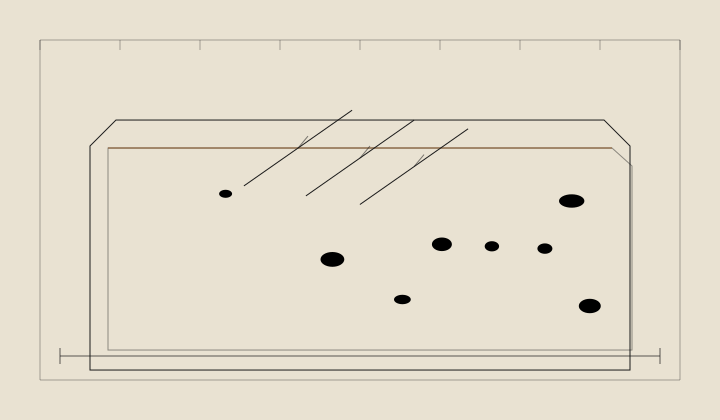
A round boule in a 22 cm banneton, rice flour dusting, seam down. The score is a wheat-stalk pattern: one central cut and three pairs of short side cuts at 35 degrees, 7 mm deep. It is decorative but not arbitrary — the pairs alternate sides so the loaf opens evenly instead of leaning.
- Steam 22 minutes at 240 °C, then 24 minutes dry. Total 46 minutes.
- Crumb rating 4/5: open, moist, faintly chewy.
- The crust stays thin; a longer dry bake makes it leathery.
Emmer absorbs water more slowly than wheat. If the dough feels dry at the first fold, do not add water — it will have caught up by the second.
Sources / 参考来源
Published reference works consulted for this log: